Wednesday, June 13, 2018

White Houses by Amy Bloom

A few years ago, when Amy Bloom's last novel, Lucky Us, came out, I read an interview with Bloom in which she said that her children said about her work: "It's always about sex and death." I thought that sounded intriguing.

So when my book group chose White Houses to read, I looked forward to it. 

White Houses is historical fiction, about the relationship between Eleanor Roosevelt and her lover, the newspaper reporter Lorena Hickok.

I didn't like the beginning. The scene in the opening chapter takes place just after the death of Franklin Roosevelt, and Eleanor and Lorena meet again after having been apart for some years. This scene emphasized the class difference between Eleanor and Lorena: Eleanor enters the apartment and sheds her clothes as she walks through it; Lorena follows, picking up Eleanor's clothes off the floor and hanging them up.

But I found as I read on that this novel was a compelling read. There's a tremendous amount written about the life of Eleanor Roosevelt, and Bloom seems to have read it all. It's clear she did a great deal of research. The narrative is full of observations about Eleanor's life, the many people she knew, and the many things she did.

We also learn about Lorena's hardscrabble rural background. This interest in the Depression and the period before it reminds me that Lucky Us was set during the depression (and partly in Hollywood).  

There's an interesting contrast, to me, between Lorena's deeply practical nature and the richness of Bloom's language. Bloom is a wonderful writer, and her prose just pulled me along.

Hereditary

I enjoyed seeing Get Out so much last year that I decided I'd take a chance and go see Hereditary. I really enjoyed it. I thought Toni Collette and Gabriel Byrne's acting was very good, and that quality of verisimilitude made the story much more scary. But, it's not too scary. In my view, just the right amount. I'd definitely recommend it.

Friday, June 8, 2018

The Book Thief by Markus Zusak

I skimmed this book last night. It's one of many on the list for the Great American Read, and one of many on that list that appeal to teens and young adults, and are suitable for parents and teens to read together.

I skimmed it because I read the first five pages or so and realized that I quite disliked the idea that the narrator of the book is a supernatural figure that invisibly gathers souls. It reminded me a little bit of The Lovely Bones, which was enormously popular at the time that I read it. This novel has been a bestseller for a very long time.

And, in fact, the framework of the narrator who sees things from above, led me, as I was reading, to see the book in very cinematic terms. In fact, as I skimmed the book there were many times that the mental pictures formed in my mind were similar to crane shots. I know that this novel was made into a movie a few years ago, and I think I'd be interested in watching the movie to see how the filmmaker's mental pictures compared with my own.

This book has been loved by many, but I imagine will not appeal to everyone. As a work of imagination, I admire Zusak's novel very greatly. I also admire that the Hubermanns were both ordinary and heroic; their story was lost as many stories have been lost. Zusak gives that lost history a record.


Monday, May 21, 2018

The Great American Read by PBS

PBS is showing an eight-part series, hosted by journalist Meredith Vieira, that be shown from May to October. The objective of the series is to get folks to read. A list of 100 books is available at the series' website. Viewers will be encouraged to read titles they haven't read before, and to vote for their favorite book.

The list was created by allowing 7200 folks to vote. I've just looked at the list of 100 titles, and I see that I've read 40 of the titles on the list. There are many YA titles, like the Hunger Games and Twilight, which I've never read. I did not include Harry Potter on my list, as I've only read the first book.

As I was going through the list, I realized that I would often come to a title, and look at it rather stupidly before remembering that I had read it and should include it on my list.

At least seven of the titles were titles that I'd read for school; many more I'd read just because I wanted to. And I had read two classic YA titles, C.S. Lewis Narnia books and Tolkien's The Lord of the Rings. My recollection is that I'd just scarfed these books up. I remember reading Gulliver's Travels as a child and then again in our Augustan Age class; of course, I understood it much better as an adult but recognized, somehow, that I felt at sea and wondered what it was that I was missing.

The list does seem to me to be heavy in YA favorites: The Giver by Lois Lowry, Looking for Alaska by John Green, The Book Thief by Markus Zusak, and Ready Player One by Ernest Cline.

Here's the entire list: http://www.pbs.org/the-great-american-read/books/#/. See how many you've read.

I think I'm definitely going to read at least one book, and perhaps it will be Looking for Alaska or perhaps the Book Thief or Their Eyes were Watching God. Years ago I read a short story by Zora Neale Thurston and I think for that reason I've been wanting to read Their Eyes for some time.

I think this is quite an ambitious project, and I love it. I look forward to participating. If you'd like to find out more about the show, here's the show's website: http://www.pbs.org/the-great-american-read/home/. The first episode will be shown here on Tuesday night at 8 pm.

Don't forget to vote for your favorite on the list. It's possible to vote every day!

Thursday, May 17, 2018

Columbine by Dave Cullen

Read this book for my book group, very reluctantly. I just have never been interested in crime stories.

My book group rated it very highly: they valued the quality of the writing, the quality of the research behind it, and the wide-ranging aspects of the reporting.

I couldn't help wanting to consider the public policy implications of what Cullen had to say about the events of that day. A mental health professional and researcher Cullen spoke came to believe that both shooters, Harris and Klebold, had undiagnosed mental health illness. Harris was a narcissistic psychopath (the shooting was originally intended to be a bombing and to demonstrated his superiority) and Klebold suffered from depression and perhaps other mental health illness. I'm grossly simplifying.

The public policy implication I inferred from the reporting in this book is that school shootings are a significant public health problem deserving of public investment. Money should be spent on research and on educating the public about the kinds of signs that troubled teenagers (and others) may display before a shooting event. Further, there is a need for school shooting reporting to be less sensationalistic (to some extent, I think the frequency of school shootings might cause that already to be happening). I recall that in The Tipping Point, Malcolm Gladwell reported a phenomenon in a South Sea island community, in which suicide had become contagious among teenagers. I think this "contagion," this impulse for teenagers to imitate each other, is very profound. We should be aware of it and act accordingly. I think that response should include not publicizing school shooters because giving school shooters notoriety is part of the problem. Although Cullen did not address this topic, I think that there is a need for a greater institutional response, including trainings, about shootings of this kind and how public administrators and front line public service providers should respond.


Thursday, March 22, 2018

Lies She Told by Cate Holahan

Lies She Told is another "twisty" tale with an unreliable narrator. For folks who found Gone Girl somewhat tiresome, if only because there was a substantial section of the book, right before the twist, that seemed a little static, this book might be a better choice. It's more simply told, it's very well-paced from the very beginning, and it's only 288 pages. I must admit that I'm a big fan of less than 300 pages.

There were certain aspects of this book that I found very engaging. It's a tale within a tale: chapters alternate between the story of Liza, a psychological suspense author who is trying to "stay in the game," and continue writing through a seeming slump in inspiration, sales, and visibility, and the Beth, the protagonist of the novel Liza is writing.

While Liza, the author, is writing her book, we see that she is suffering from anxiety that her publisher will drop her for low sales, and she is constantly anxious about continuing to write, finishing her chapters, meeting her deadlines, and negotiating her relationship with her editor - even when she is suffering from migraine headaches. She is anxious. She dreads attending a conference where she will attempt to promote her last published book, which did not sell well. This "day-in-the-life" snapshot of a midlist published author was clever and funny, and I enjoyed it. And underneath the plot, and the suffering of the characters (both the author, Liza, and her character, Beth, are married to men keeping secrets from their wives) I felt a kind of breathless exuberance.

I was surprised again that I picked up on some clues and foresaw some elements of the plot. That's not like me; I'm usually quite surprised to find out who the killer is.

Nevertheless, the closing chapters of the book are suspenseful and full of revelations that I did not see coming.

I think this book will entertain folks who love a twisty tale but found Gone Girl too long. The fast-paced narrative makes it a good choice for travel.

Lies She Told is author Holahan's third book; the first were Dark Turns (I love a book title that telegraphs the delights to be found inside) and The Widower's Wife.

Monday, March 12, 2018

Outcasts United: A Refugee Team, An American Town by Warren St. John

This nonfiction book written by a reporter from the New York Times, is part sports story, part human interest story, part sociological study.

My book group read this book, and it was chosen because the author was doing some promotion locally. It's obvious to me that promotion works: I just read a sports book!

It's also a wonderful thing to visit this book, written in 2009, about immigrants working together and about what they can contribute to a community.

In this book, of course, part of what the refugees in the story are offering are their soccer skills, honed in alleys and streets and dusty fields. But something else these refugees offer to the people who are helping them and others around them is resilience, strength, gratitude, and love of family.

In Clarkston, Georgia, refugees are resettled in inexpensive apartment complexes on the edge of town. Gradually, their numbers grow and their presence begins to change the nature of the town.

Refugees have many problems. They have to work in order to support their families, but they often speak little or no English. Refugees are lent the money for the tickets to the U.S.; they receive only three months of assistance. They've often experienced terrible trauma, witnessing acts of violence and sometimes witnessing acts of violence against members of their own family.

A Jordanian immigrant, Luma Mufleh, a graduate of Smith College, moves to Georgia because the weather reminds her of her home. She is a former soccer player and a huge fan. She starts coaching soccer because she enjoys it so much and feels inspired by her own coach as a child, an American woman married to a diplomat living in Jordan.

Eventually, she stumbles upon the immigrant community in Clarkston, and decides that she would like to coach soccer there. She recognizes that poverty and trauma place special stresses on these refugee kids, and that's part of what motivates her.

This book is the story of how she succeeding in overcoming her teams' lack of experience of team discipline, their occasional need to act out, the lack of funding for equipment, and succeeded not only in helping all her soccer players to play better soccer, to have a social and comforting experience where they can make new friends, be kept busy doing something that they love and kept out of trouble, and learn to work together as a team with people from different backgrounds, and leadership skills.

I fell in love with the book around the third page. I just felt absorbed in the stories of Luma and wanted to learn more about her and the young men she was working with in her soccer program.

My book group found the writing style here somewhat plain. I too, initially saw St. John's writing style that way. However, by the fifth page, I was completely engrossed. I was just so curious about how Luma would solve the team's problems, how she'd manage her relationship with the YMCA who subsidized the program by renting a field for the team and providing a bus, and her relationship with the young soccer players in her program.

Some of the problems that Luma encountered were that the community center where the YMCA rented a field for her really didn't want the team to practice there. Eventually, the community center ended the relationship, leaving Luma's team with no place to play. No specific reason was given, I think, but the inference I drew was that the refugee children on the team were viewed as outsiders to the community.

Since the events chronicled in the book, things have changed in Clarkston. While many residents moved away, new residents who appreciated being in a diverse community moved in. A new mayor, a younger man who embraced Clarkston's diversity, was elected.

I googled Luma and found that she is attempting to raise money for a new facility to provide soccer programs for children in Clarkston. I think that that sports facility would be an asset to the community, and I cannot help being pleased that the diversity that immigration brings is now valued in Clarkston.


Friday, February 23, 2018

The Wicked Girls by Alex Marwood

This is a wonderful suspense novel. It's what I call a "twisty tale," a thriller with a wonderful twist at the end that you never see coming.

I'd been interested in reading this novel for some time, ever since I'd read Stephen King's enthusiastic assessment in one of his end-of-the-year "best of" columns he writes for Entertainment Weekly. What struck me was that he is a very skilled writer, and he obviously believed that Alex Marwood is one, too. His admiration filled me with curiosity. I couldn't help thinking, with this recommendation, this book must be great.

What I see here is a wonderfully suspenseful novel, written in a very colloquial, accessible manner, with lots of real-life details that gives it a great sense of reality and immediacy, as well as finely drawn characters. 

This is a hard novel to summarize, because the plot is intricate. Kirsty Lindsay is a stringer, a freelance journalist. Two murders have occurred in Whitmouth, a seaside resort town. When a third murder occurs, Kirsty is sent to cover the murders. The police aren't releasing much information; in her desperation to find something to write about that isn't already on the AP wire, she bribes her way into the scene of the third murder, the hall of mirrors in an amusement park. In the event, she isn't actually able to get inside, but she encounters someone shocking: someone whom she hasn't seen since she was a child, and who will change her life forever.

I think this book will appeal to fans of Gone Girl and Girl on the Train who would enjoy a twisty tale without the marriage element.

My Penguin paperback has admiring blurbs by other thriller writers on the front, the back, and in the first two pages. My favorite quote was from Elizabeth Haynes. She wrote: "I loved it. I thought it was a brilliant exploration of the sins of the past colliding with the mistakes of the present; really well-written, multi-faceted characters, who behave in ways you wouldn't expect them to: in other words, like real people."

I really felt that in addition to being well-crafted, this book was thoughtful. India Knight called it "haunting," and that's how I feel. I found myself feeling really engaged with this story, as if it were happening down the street.

Alex Marwood is the pseudonym of journalist living in London, Serena Mackesy. The Wicked Girls came out in 2012 and won the Edgar Award for Best Paperback Original in 2014; she has since published two other books, The Killer Next Door and The Darkest Secret.

Saturday, November 18, 2017

When We Were Yours by Lisa Wingate

This is a very entertaining historical fiction novel based on a real life incident/scandal.

Rill is a 12-year-old girl who lives a romantic and very unconventional life as a river rat. She and her family live on a river house boat, on the Mississippi River. The house boat is tied up near Memphis as the novel opens.

Tragedy strikes her family when her mother confronts a difficult childbirth and her father takes her mother to a nearby hospital. Before her parents return, the police arrive with a woman who removes all five of the children from the house boat and takes them to a boarding house filled with other children who are wards of the state.  Not all of them are orphans; some have been actually been snatched off the street. Most have been signed away by their parents, but not always with their parents' true consent.

I read this with a book group and the members offered a lot of opinions that I found worth noting. Two folks thought that Wingate is a beautiful prose stylist; I agree. Several folks noted that the structure of the plot was quite predictable. I agree with this point as well, and, in fact, while I was reading the book I felt that I knew almost exactly what was going to happen and what was going to be revealed. Usually, I'm not that far-sighted when reading fiction and, unlike many mystery readers I've met, not good at guessing the murderer. Interestingly, a lot of libraries didn't have this book when we book group readers went to the library to try to get it; I think that this historical fiction was a little bit of a departure for Wingate. Wingate has won a Christy award.

I got the impression that several members of the group enjoyed the book even while recognizing some of its weaknesses, because it had a lively plot told in a suspenseful way and wasn't too challenging.

There were a couple of other things that made an impression on me. The primary point of the story is that children were treated as if they were commodities; however, there was also abuse of various kinds, including sexual abuse. I initially felt so uncomfortable with this, and even described it as "lurid" to someone to whom I was explaining the book; but, a few days after that conversation I was hanging laundry on the line and listening to the radio and heard a story about sexual abuse of Australian orphans, and this caused me to remember stories of child sexual abuse in Ireland and in our own country, and I realized that what I viewed as sensationalism was really commonplace.

I liked the setting at the beginning of the novel. I didn't know that folks lived on the river. I found that interesting.

War and Peace (BBC, 2015)

Really enjoyed this Andrew Davies-penned adaptation of Tolstoy's novel about the French invasion during the Napoleonic wars of the early 19th century.I love costume dramas, and this one has a fine cast, but what I love most about it are Lily James' and Paul Dano's performances. Paul Dano plays Pierre, who is at the center of the story, and who is perhaps a character who is somewhat aubiographical. Pierre is a self--effacing sort, and the "natural" (illegitimate) son of a wealthy nobleman. Unexpectedly, Pierre inherits his father's title and estate. This sudden change in his circumstances is a bit overwhelming for Pierre, and he is persuaded to make a marriage to a woman who is beautiful, popular and well-connected, but who does not love Pierre and only agrees to marry him because he is rich and she has no money of her own.

The woman Pierre does love is named Natasha. They have been part of the same social set since Pierre was a child, and she eventually meets and falls in love with Andrei, Pierre's great friend.

Meanwhile, Russia fights Napoleon as an ally of Austria. Later, Napoleon invades Russia. The war is a frightful experience for all of Pierre's friends. Pierre himself, although once an admirer of Napoleon, has changed his opinion and goes to the battlefield, hoping for  a chance to assassinate the French general. Instead, he becomes a prisoner of war and is forced on a death march led ed by the French army. Pierre is rescued by Russian soldiers, but so many of Pierre's acquaintance have perished or lost their property that Pierre's world after the war is shrunken and somber. Pierre's attempts to grapple with first, social justice in his own country and in the larger world, and his struggle the assimilate the trauma of the war, are at the heart of this novel.

As the miniseries ended, I found myself feeling that there was something so familiar about this story - and then I realized that it reminded me of Voltaire's Candide.


Thursday, September 28, 2017

Can Jane Eyre be Happy?: More Puzzles in Classic Fiction by John Sutherland

Published in 1997, this book is actually a follow-up to Is Heathcliff a Murderer? Can Jane Eyre Be Happy offers a number of short essays on questions in classic fiction and their possible answers.

The title essay, Can Jane Eyre Be Happy? reveals that Bluebeard was a commonly collected fairy tale for children in the Victorian era. The author states that Jane Eyre contains several references to the Bluebeard tale and is a kind of re-telling of it. As a self-avowed vacuous reader of fiction, the questions raised here about Rochester's character and motivations, and Jane's future happiness, had never occurred to me before.

Sutherland's essay on Jane Eyre begins by noting that editor Margaret Smith, in her critical introduction to the Oxford University Press World Classics edition of the novel, correctly notes the influences of the Bible, Bunyan (author of The Pilgrim's Progress, less known today in this country although it is mentioned in Louisa May Alcott's Little Women), Shakespeare, Scott and Wordsworth. He goes on to note that an omission in her list is the tale of Bluebeard, a fairy tale retold by French fairy tale collector Perrault and well known to Victorian children. (Interestingly, Bluebeard did not appear in my Andrew Lang book or my Signet The Twelve Dancing Princesses.)

Bluebeard marries a young woman and when he has to go on a trip, he gives his wife the keys to the house and instructs not to enter a specific room. Curiosity gets the best of her and she enters the room only to discover the corpses of Bluebeard's former wives. Her husband returns and a drop of blood on the key for the forbidden room betrays the wife's secret. In mortal peril, the bride is saved by the arrival of her brothers, who kill Bluebeard.

Sutherland argues that the loss of Rochester's first wife Bertha in the fire at Thornfield Hall is convenient for him and even that the innkeeper's testimony that he saw Bertha fall is "clearly" a reiteration verbatim of his testimony at the coroner's inquest, with the implication that his role as a businessman in the community gives him a motive for exonerating Rochester. Sutherland asks why Rochester didn't commit his wife to one of the new, much more humane sanitariums then already in existence in England. He sees Grace Poole's alcoholism as impairment of her fitness for her role as keeper and as casting further doubt on Rochester's true motivations. He explains Blanche Ingram's visit as a sign that Rochester has determined to marry again despite the fact that it is bigamy and opines that Rochester's interest in Jane is due to a proposed match with Ingram being thwarted by the arrival of Bertha's brother.

Further, Sutherland sees Mrs. Fairfax's role as that of a wise protector of Jane, and her dismissal by Fairfax as evidence of his desire to hide his criminal intent to commit bigamy.

Given that Rochester may have murdered his first wife and Mrs. Fairfax is gone, is Jane Eyre safe with Rochester and likely to be happy? Sutherland mentions that Rochester is blinded by his accident during the fire and argues that his disability and reduced agency may transform him from bigamist to more suitablem or at least, less threatening, husband for Jane.

Sutherland concludes, "But what if, like Edward Rochester, after years of marriage, his sight were to return and -- barring the blemish of a missing hand (common enough, and even rather glamorous in these post-war years) -- Bluebeard still cut a handsome figure. Could one be entirely confident that his wife-killing way would not return?"

Sutherland's conclusion really surprised me because I had always thought of the story of Jane Eye as a woman's empowerment story: Jane is (eventually) able to marry the man she loves despite the fact that she is: plain, an orphan, and poor. Seeing Jane Eyre as a re-telling of the Blackbeard story turns my vision of the meaning of the Jane Eyre story on its head.

If this idea Jane Eyre as a retelling of the Blackbeard story intrigues you, you might enjoy reading this well-supported student essay on this theme:   http://bit.ly/2hzbCfX.

There are a lot of other essays on favorite novels here: an essay on the vulgarity of Mrs. Elton in Emma, the paternity of Tom Jones in Tom Jones (it never occurred to me to wonder), how Mrs. Dalloway gets home so quickly from her excursion to get flowers the day of her party, the gender of Lady Bertram's pug in Mansfield Park, Tristram Shandy, Fanny Hill, The Mill on the Floss, Adam Bede, Barchester Towers, Hardy's A Pair of Blue Eyes (I'd never even heard of this).

Postscript: After I'd read this book, including its essay on Mill on the Floss which concludes that George Eliot was no sailor, I thought of that essay again when I was reading When We Were Yours.
There's an exciting scene where the houseboat of the family in the story is unmoored, drifts out on the river, and breaks up. I found it hard to follow the action, even though it was exciting, and it reminded me of this essay; I wondered if perhaps the fact that I am no sailor made it more difficult for me to understand.


Sunday, September 24, 2017

Cold Comfort Farm (1996)

This 1995 movie has a wonderful cast and is very funny. In fact, 71% of those who rated it on Amazon.com gave it five stars; Rotten Tomatoes gave it an 83% rating. My favorite scene is when Seth, the movie-mad farm laborer played by Rufus Sewell, agrees that he would very much like to be a star of the silver screen. I'm still laughing about it.

Kate Beckinsale plays a young woman, Flora Poste, who has recently been orphaned; having learned that she has only 100 pounds a year to live on, and having a desire to become a writer, she thinks she will try bunking in with whichever interesting relative will agree to host her. Judith Starkadder (Eileen Atkins) writes her a cryptic letter in which she refers to some wrong done Flora's father in the past, and which also contains a reference to Flora's "rights," without any further explanation. As decidedly rural as Judith's home, Cold Comfort Farm must be, Flora thinks that these mysterious references hold out the greatest promise of a grand adventure, and accepts her cousin's invitation. As she tells her confidante, Mrs. Smiley, she's quite sure she will encounter some cousins that will be named Reuben and Seth; sure enough, her cousins are named Reuben and Seth.

With a cast that includes Ian McKellen as a fire and brimstone preacher, this comic send-up of novels about women coming-of-age is very amusing.

Friday, September 1, 2017

Middlemarch (BBC, 1994)


I watched the 1994 BBC production of Middlemarch on DVD. (My library didn't have it, but was able to borrow it from another library through interlibrary loan.) Middlemarch was wonderful, and it captured the spirit of the novel. I did think that the story suffered from being compressed into six hours or so.  Although it is clear that Ladislaw and Dorothea love each other by the end of the series, they met so infrequently that I felt I couldn't see that their behavior was sufficiently motivated. I recall that when I read the novel I felt that Ladislaw and Dorothea had some sophomoric conversations. That's absent here. I'm not sure that it matters: that sense of wistfulness and compromise about the end of Lydgate and Dorothea's stories has been preserved.

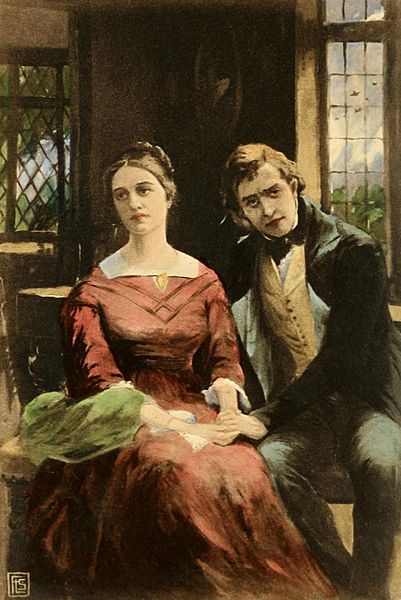
File:Dorothea and Will Ladislaw.jpg
Dorothea and Ladislaw, from a 1910 edition of the novel by Jenkins Publishing

On the other hand, the performances of Casaubon (Patrick Malahide) and Rosamund Vincy (Trevyn McDowell) were so fine that I felt that they really enhanced my understanding of the issues in the novel. Perhaps the actors were kinder to these characters than George Eliot was - I'm not sure, because it's been years since I read the novel. Almost certainly I have changed since I read the novel.

There's only one "special feature" on the DVD. It's a "Reader's Guide to Middlemarch," and I loved it. David Lodge, Howard Jacobson, A.S. Byatt and Clare Tomalin, Kate Flint, screenwriter Andrew Davies, as well as some members of the George Eliot Fellowship, talk about the novel in a very thoughtful way. The ladies and gentleman of the George Eliot Fellowship have some things to say which I think student readers will find helpful: Eliot's portrait is realistic, not romantic, and reflects our real lives (and gives us an opportunity to recognize ourselves); Eliot's realism includes writing about the real jobs that people have; Eliot not only offers realistic portraits but tremendous psychological insight into why people behave the way that they do.

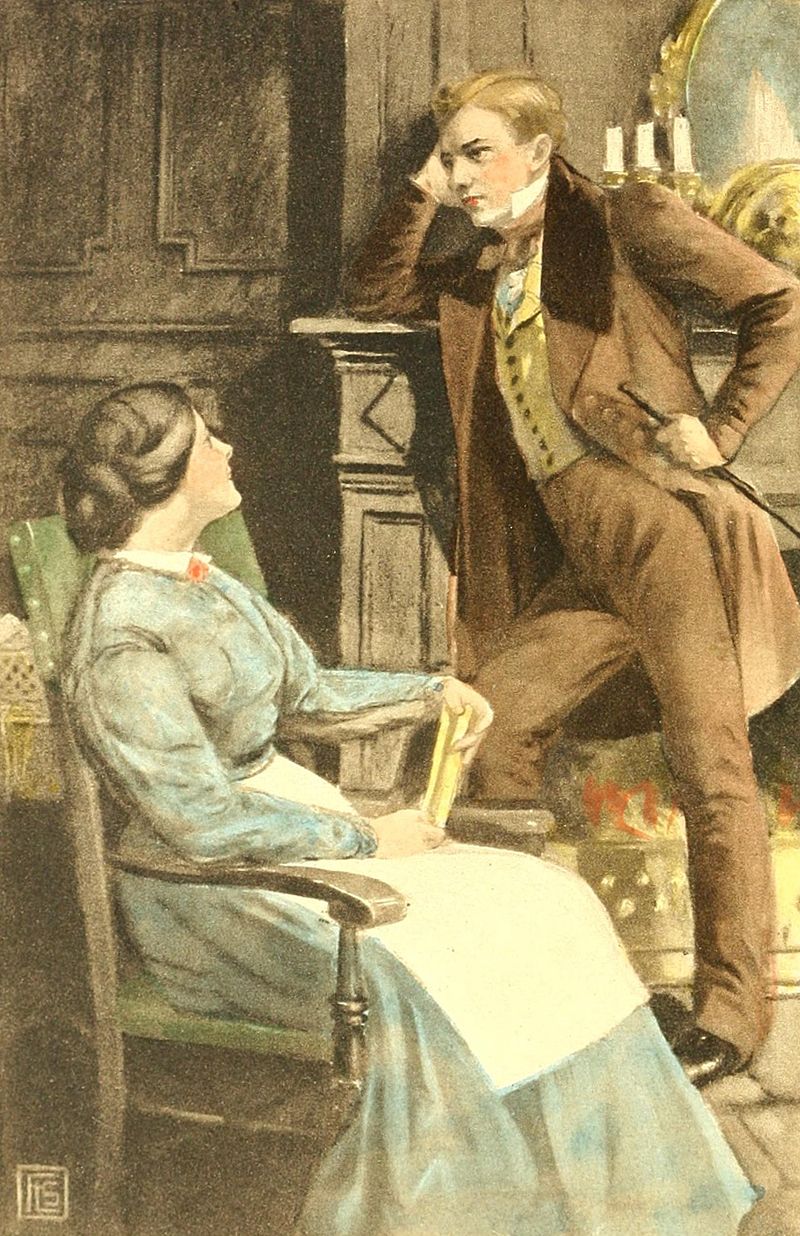
Mary Garth and Fred Vincy.jpg
Mary Garth and Fred Vincy, from the same edition

Rosamund and Tertius Lydgate, from the same edition
Davies' enthusiasm is charming and infectious, opining that watching the TV series will inspire viewers to read the book: he says that he hopes viewers will become "George Eliot buffs." Kate Flint tells a wonderful story about being on a bus, reading Middlemarch, coming upon the passage in Middlemarch where Dorothea realizes that her husband has emotional needs just as she has, and suddenly realizing that all the people on the bus sitting around her all had emotional needs too. Terry Eagleton explains that the novel is set in a time of political tumult, in which the reform bill of 1832 promised reform of the parliamentary electoral system and to extend the franchise to people in cities, reducing the influence of the aristocracy and the landed class. Howard Jacobson warns against reading the novel for its romance and promises that if he sees a woman reading the novel in a vacuous way on a train, he will seize the novel and throw it from the train. Since reading novels in a vacuous way is the only way I ever do it, I am quite grateful for the many miles between us. In Mr. Jacobson's defense, being a caretaker of culture is a dirty job, but somebody's gotta do it.

I think that the "Reader's Guide" provides excellent answers to the question, "Why is Middlemarch important?" and I think students will find its discussion enlightening and helpful.